
Posture Correction Centennial, CO
- Improve Spinal Alignment
- Reduce Muscle Strain
- Personalized Posture Plans
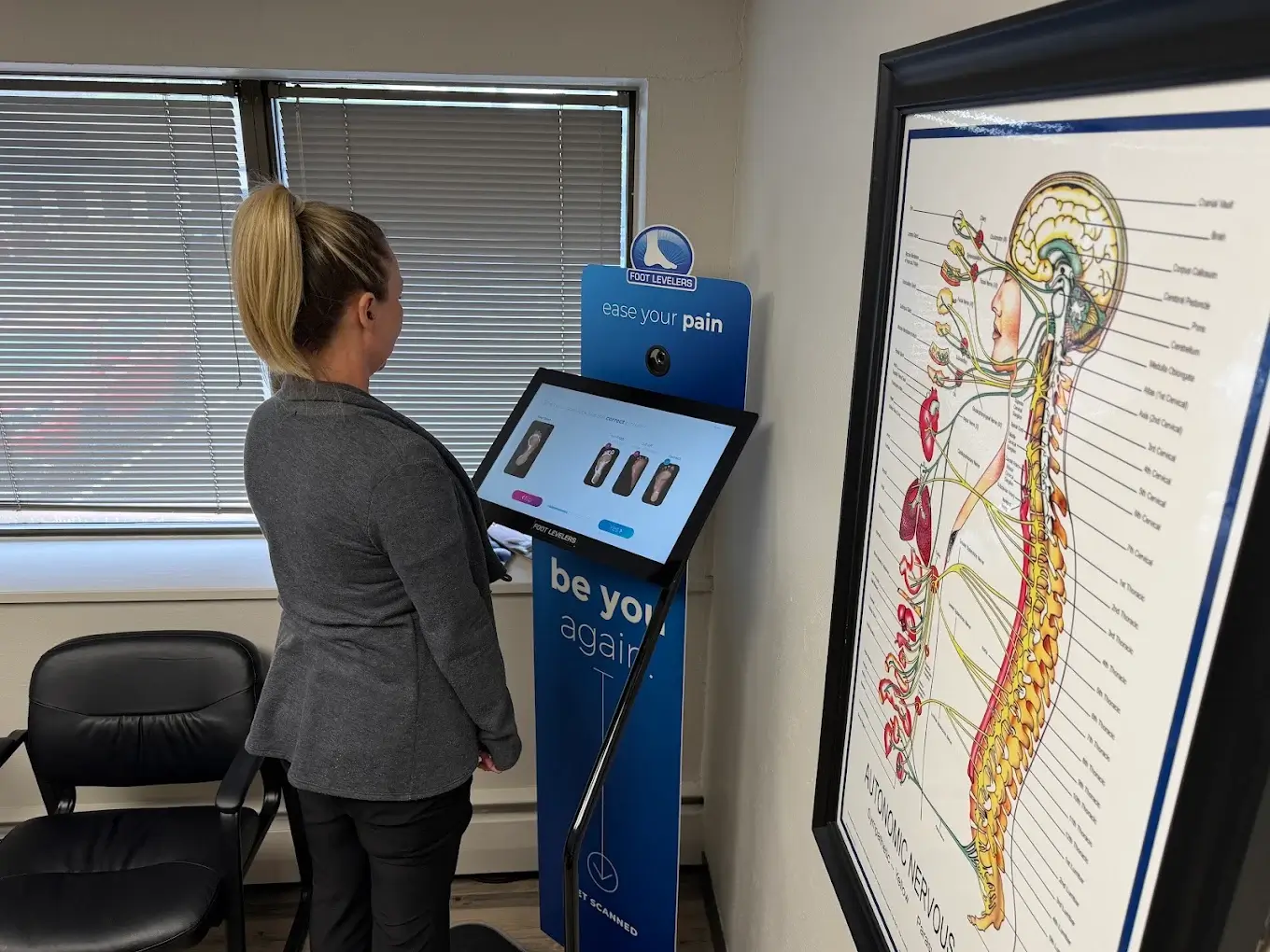
Posture Correction at Axis Health and Wellness in Centennial is a type of non-surgical therapy that goes after the structure. Dr. Tony Nicholas can fix your rounded upper back or your head in front of your shoulders.
You might have tried to fix your posture by sitting up straight at your desk, only to realize that your upper back is hunching again. This can be frustrating. However, you fail not because you lack discipline but because your body has already settled into.
When you visit Dr. Tony at his chiropractic clinic in Centennial, you will undergo a battery of tests, including X-rays. Imaging is necessary so our chiropractor can measure where your spine sits. He can then work on a plan to change the alignment of your spine. His technique in structural correction is based on chiropractic biophysics.
What Posture Correction Means
Posture correction means changing where your bones sit. This treatment is different from stretching or getting temporary relief.
Your spine has natural curves, like a forward curve in your neck, a backward curve through your mid-back, and a forward curve in your low back. They are vital to allow your spine to absorb load and let the nerves stay uncrowded.
When those curves flatten or shift, everything adapts. Muscles work overtime just to hold your head, which is no longer sitting over your shoulders. Your joints get loaded in directions they were not designed for. The nerve roots that exit the spine will have less room than they need. Pain may arise as the last symptom. And this is where posture correction becomes beneficial.
Why Sitting Up Straight Never Sticks
Sitting up straight never sticks because your muscles can’t do the job that the structure is designed to do. Holding proper posture by willpower means that your muscles contract all day long. Unfortunately, not all people can do it.
The moment you get absorbed in a conversation, for instance, your attention goes elsewhere, and you drop back into whatever your skeleton finds easiest. If your skeleton has been hunching back for 15 years, the easy position is the wrong one.
Once you change the alignment, good posture will no longer take effort. This is the idea of posture correction.
What Poor Posture is Costing You
Most people arrive at our Centennial office because of a symptom. The following are symptoms that many patients experience:
Headaches and Breathing
Around 90 percent of headaches and migraines start in the upper neck. Then, the pain wraps around your head or settles behind your eye. These are cervicogenic headaches that are caused by misalignments of your cervical spine. The misalignment presses on nerves that feed the head and neck. This is the reason you feel a band of tension around your skull. If your head lives out in front of your shoulders, then this is the exact setup.
After headache, there’s breathing. Spine misalignment causes a pinched nerve in the mid-back. It can make it difficult to take a full, deep breath. You may describe it as shortness of breath, so you go to a cardiologist or a pulmonologist. What you don’t know is that the actual problem is mechanical and sits between your shoulder blades.
Measure and Not Guessing
Here at Axis Health and Wellness, we don’t just look at you from the side and tell you that you have bad posture. Instead, we take X-ray images of your back to better understand what’s going on internally. The film will tell us the actual angle of the curve, the degeneration that has already happened, and how old your injuries are. We believe that correcting a structure requires measuring it first.
The X-ray images also give us a starting line. We don’t measure your progress based on how you feel every week. We have a starting line that we can compare against.
“Taking x-rays on patients lets us understand what internally could be wrong that we can see, and not just be guessing. That is the whole point. I want to know what I am working with before I tell somebody what it is going to take.”
Dr. Tony Nicholas, D.C.Posture Correction and Chiropractic Biophysics as The Method Behind
Also known as CBP, chiropractic biophysics is the technique designed to correct structural problems, instead of just relieving symptoms. General chiropractic care aims to restore motion and ease your pain. But CBP aims at moving the spine closer to its normal alignment. It uses X-rays to define the target and check whether you’re getting there.
Dr. Tony has been practicing this method for so long now. He served as a chiropractic biophysics club president in college and got certified in the technique. Although he no longer keeps up with the certification classes, he still practices this way in his office every day. This is how he thinks about spines.
To know more about this method, please visit our chiropractic biophysics page.
The Two Phases of Posture Correction
When patients walk into our chiropractic office, they don’t want posture work. Rather, they walk in so much pain. Hence, proper care can be in two stages.
- Relief. This is for an acute issue. Posture correction care starts at two to three visits per week. The goal here is to get you out of pain. Nothing structural is happening yet.
- Structural correction. When your pain dwindles, your visits drop to one or two a week. The work also shifts to changing the alignment. This is an optional phase.
Most people stop at the first phase because they already feel fine. They think that feeling fine means that the problem has been fixed. However, even if you’re already out of pain, you’re still not fully healed. Some people take the relief and won’t proceed to the second phase. Others want the structure to be fixed so the problem will never recur.
How Long Does Posture Correction Take?
There’s no definite answer to this question. Your structural problem took years to form. It will not move back in just a few days or a week.
If your structural problem has been there for a decade, it can take longer than if the problem just started a few days ago. Age also affects the duration of the treatment. Younger people heal faster than a 60-year-old. Other factors that affect the duration include your weight, diet, and overall health.
Every week, Dr. Tony will reevaluate you. Thus, your plan may change depending on how your condition improves. Even if Dr. Tony recommended 12 visits during your initial consultation with him, this can change after re-evaluation.
When Posture Is Not the Real Issue
There are cases where the alignment is not the main culprit that drives your symptoms. Dr. Tony will investigate it instead of keeping on doing the wrong thing.
- If care doesn’t show results by 8 to 12 visits, Dr. Tony stops the plan.
- Emergency signs, like balance problems or genuine shortness of breath, must be treated at the medical doctor’s office.
- Loss of bowel or bladder control or you experience extreme pain requires you to go to the emergency room
- Numbness that spreads into your face must be investigated to rule out stroke
Sometimes, the solution to your problem is a different tool, instead of a different doctor. For instance, you may need spinal decompression if there’s a disc involved. This kind of non-surgical procedure can relieve a low back that has been tight for years.
Posture Correction FAQs
Can a bad posture actually be corrected, or only managed?
Yes, a bad posture can be corrected by fixing your structural problems. This is the premise of chiropractic biophysics. It’s also the reason that care aimed at correction is measured against X-rays instead of judging how you feel that week.
The changes you experience depend on how long you’ve been carrying the issue. Your age and overall health can also affect how you respond to the treatment. Dr. Tony will tell you whether or not your situation can be corrected or managed.
What is forward head posture?
Forward head posture is when your head sits out in front of your shoulders and not stacked over them. This is usually paired with a rounded upper back. This is the classic desk and phone posture, also known as tech neck.
When your head drifts forward, it’s hard for your neck and upper back muscles to work just to hold it up every day. The constant load is where the trap spasm, the stiffness, and the headaches come from.
Do I need X-rays for posture correction?
Yes. You need X-rays for posture correction. X-rays are not optional because they show us what is going on inside, rather than leaving us to guess. The images can show us the actual angles of your curves, degeneration, old injuries, and anything that can change the approach of the correction.
The X-rays also give us a measurable baseline. Correcting your posture takes a lot of time. We don’t gauge your progress based on how you feel. Thus, we need something objective to compare against.
How long does posture correction take?
Posture correction can take longer than pain relief. Acute care starts at two to three visits per week to get you out of pain. It drops to one or two a week once the structural work starts. If the problem has existed for so long, it can take longer to correct it. Every week, you will be re-evaluated, and Dr. Tony will adjust your plan. There is no fixed package when it comes to posture correction.
Can bad posture cause headaches?
Very often, bad posture can cause headaches. About 90 percent of headaches and migraines start in the upper neck and radiate around the head. It also settles behind your eye. The reason for this is that the misalignments in the cervical spine press on the nerves that feed the head and neck. This produces the band of tension around the skull.
If your headaches come with slurred speech, trouble hearing, dizziness, or faintness, you should get medical attention first. If serious medical issues have been ruled out, see our headaches and migraines page.
Can posture cause trouble taking a deep breath?
Bad posture can cause a pinched nerve in your middle back. It makes it hard to take a full, deep breath. The patient describes it as shortness of breath. It is a mechanical problem that sits between the shoulder blades, instead of a lung problem.
Real shortness of breath can be an emergency sign. You must seek medical attention first. You can come and see Dr. Tony if your heart and lungs check out.
Am I too old to fix my posture?
You’re not too old to fix your bad posture. Older spines change more slowly. But it is possible to fix your posture no matter your age. Younger patients heal faster and more quickly. Years of degeneration are also taken into account in determining how much fix is realistic for your case. But improving your spine alignment and getting you out of pain are possible.
Dr. Tony will examine you thoroughly, and X-rays will tell you the realistic outcome.
Will a posture brace or corrector fix my posture?
A posture brace or corrector can hold you in position while you’re wearing it. But it doesn’t change the alignment underneath. It does the work your own muscles must be doing. Thus, the structure will still be the same when you take it off.
But you can wear it as a reminder. It doesn’t correct your posture. The best correction is treating your spine, which is what chiropractic adjustments and structural care are for.
See What Your Spine Is Actually Doing, for $29
Dr. Tony will examine you, take x-rays so nobody is guessing at your alignment, and tell you honestly what correction is realistic in your case. Axis Health and Wellness has served Centennial, Greenwood Village, Lone Tree, Highlands Ranch, Littleton, Aurora, Parker, Castle Rock, and the south Denver metro since 1997.