
SoftWave Therapy Centennial, CO
- Non-Invasive Treatment
- Supports Natural Healing
- No Downtime
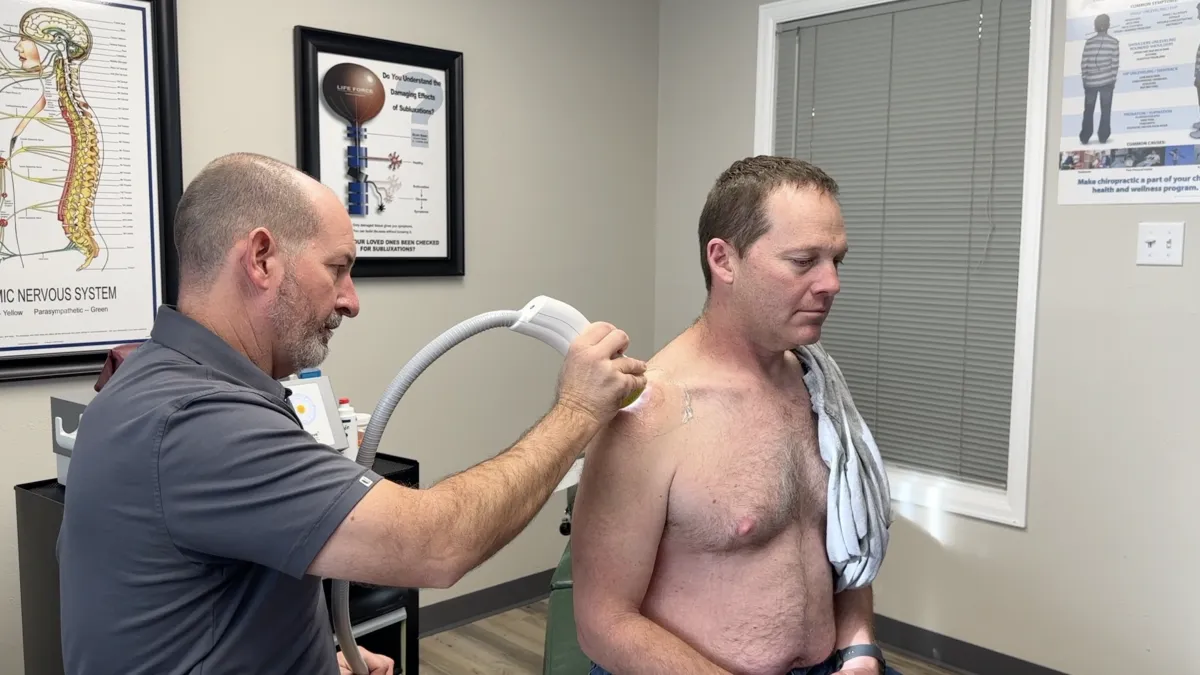
SoftWave therapy is one reason many people visit Axis Health and Wellness in Centennial. It’s a non-invasive treatment that sends acoustic sound waves into a damaged joint or tendon. Dr. Tony Nicholas brought this machine into the office because of knee and shoulder pain, and it has changed how he treats both areas.
For knee and shoulder pain, the usual treatment is cortisone. It can buy you a few months. Then, if you take some anti-inflammatories, they can only upset your stomach. The conversation that you don’t want to hear is the word “replacement” for the knee that you want to keep. Without proper treatment, however, stairs can become a negotiation. It takes longer for you to get out of the car. Each time you put weight on your knee, you have that grinding feeling.
That’s why many people visit our Centennial office for SoftWave therapy. Its goal is to activate your own healing response without needles and incisions. There’s no downtime, and it can take about 10 minutes to complete.
What SoftWave Therapy Is
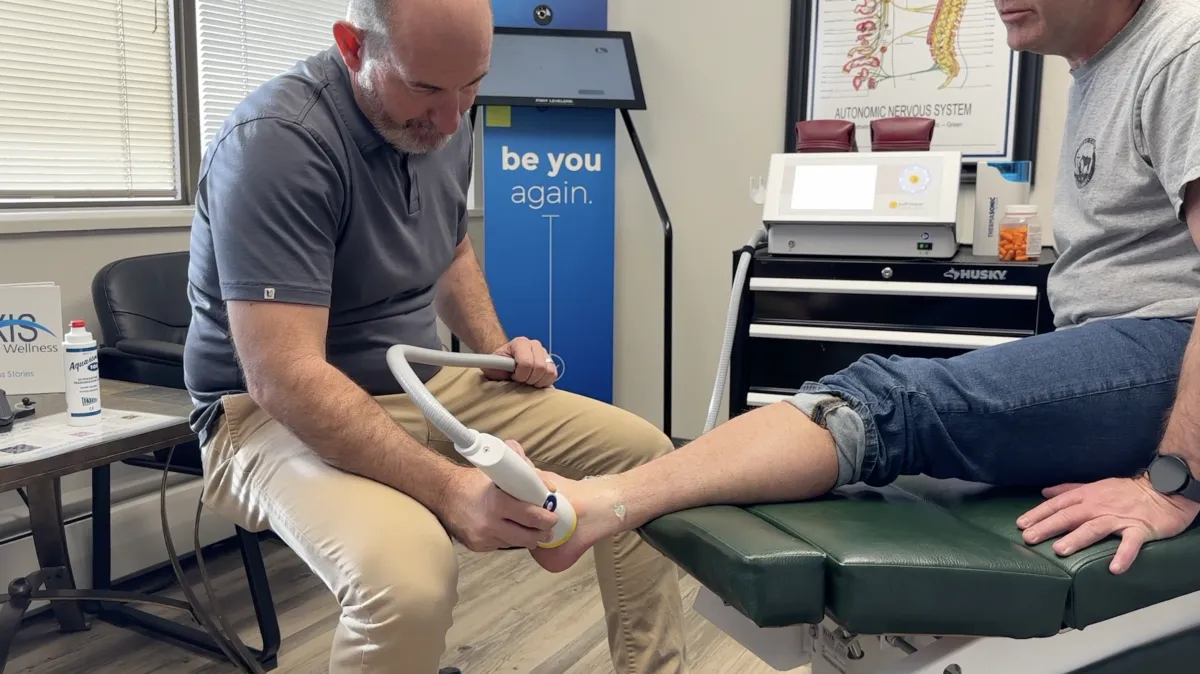
SoftWave Therapy delivers hyperparabolic sound waves into targeted tissue through a handheld stylus. It looks like an ultrasound. Dr. Tony applies gel to the area, the machine is turned on, and the applicator moves over the damaged area while the sound waves travel into the joint underneath.
The most interesting part is when the waves get into the damaged tissues. They increase blood flow and stimulate the stem cells in the tissue. This process doesn’t mask the signal. Rather, it stimulates the tissue to repair itself. That’s why it’s considered a regenerative therapy, instead of pain management.
Also known as extracorporeal shockwave therapy, this type of acoustic wave treatment has been studied in hundreds of published clinical trials and reviews for tendon and joint conditions.
- Not invasive (no incisions and no needles)
- It takes 10 minutes per treatment
- Low to no side effects, with a short list of contraindications
- Pairs well with chiropractic care as it works on the joint itself
How SoftWave Works
SoftWave works by tricking your brain into thinking that area is being injured over and over, when it’s actually not. There’s no actual tissue damage. However, your brain doesn’t know it. Thus, it responds to injury by sending blood and stem cells to the site to repair it.
In chronic pain, the condition has been going on long enough. As a result, your brain shuts its healing mechanism off for that area. This is the reason the pain level in your knee has been the same for six years. With SoftWave therapy, it flips that switch back on so the healing process starts over.
“I bought this machine because of knee and shoulder pain. That is it. It was just a much better way to treat those conditions than traditional chiropractic on its own, and once it was in the office I stopped doing knees any other way.”
Dr. Tony Nicholas, D.C.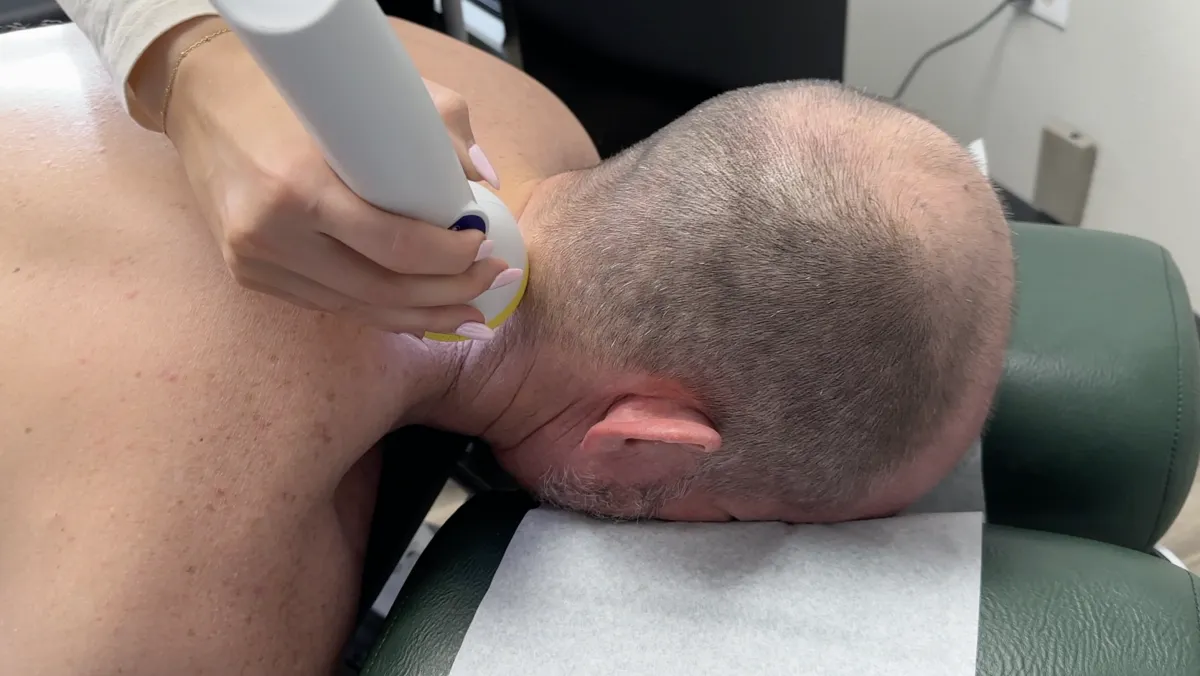
What SoftWave Therapy Can Treat
You can be a good candidate if you have a joint problem. These are the most popular cases that come through our door most often:
- Arthritic and damaged knees
- Rotator cuff and arthritic shoulders
- Tendinopathy and tendinosis
- Hip pain
- Torn meniscus
- Plantar fasciitis and heel pain
- Ankle and foot joint pain
- Osgood-Schlatter and Sever’s disease
When Dr. Tony started treating his patients using SoftWave therapy, he rarely treated a knee with chiropractic alone. That’s because SoftWave and chiropractic offer better results. It’s the same with shoulder conditions, especially the ones that feel fine at rest. But the second you reach for something on a high shelf, it gives you a sharp, stabbing pain.
Surprising Results
There are two things that Dr. Tony didn’t expect. Running the applicator over the upper cervical area seems to help with headaches. It offers the same results for patients who are dealing with the aftermath of brain trauma. He also uses this therapy as part of his neuropathy protocol, along with red light therapy, electrical stimulation, and nutritional support.
What a SoftWave Session Looks Like
- It starts with a consultation and examination with Dr. Tony. This is vital so he knows what he’s treating and where your pain level sits.
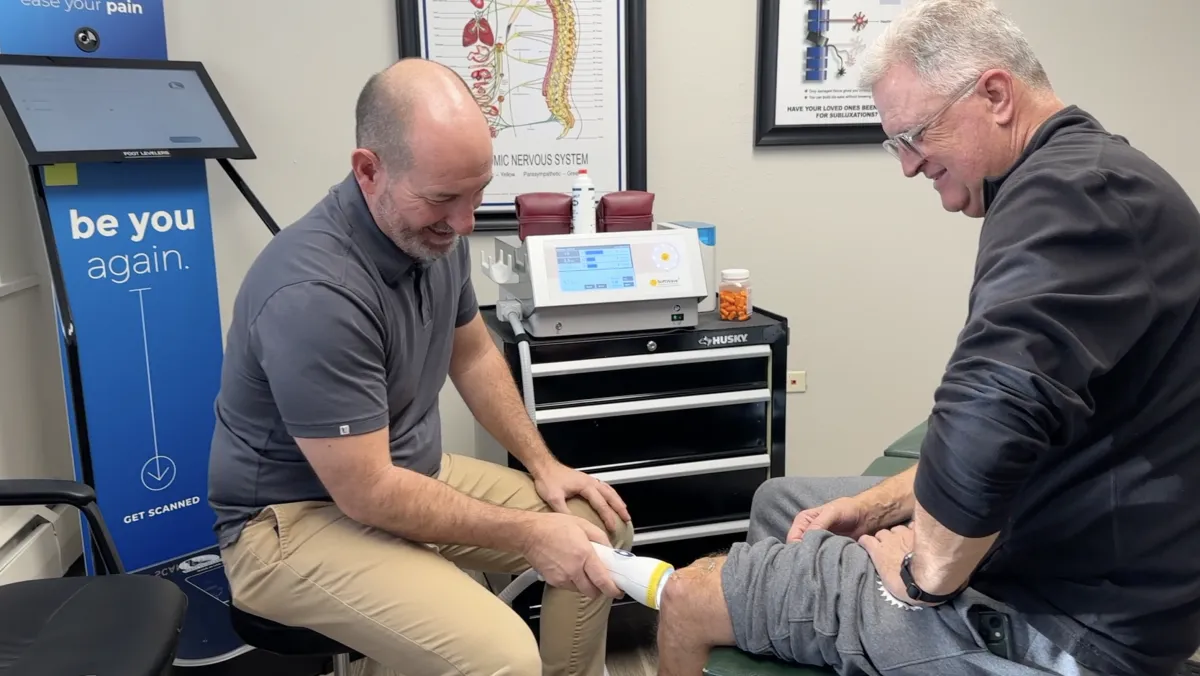
- During SoftWave therapy, Dr. Tony applies gel to the affected area, exactly like an ultrasound. You stay fully clothed throughout the process.
- The stylus moves over the target issue as the sound waves work. It feels like a firm tapping sensation. It’s not painful at all.
- About 10 minutes later, the session is over. There’s no downtime or recovery. And this is one of the reasons some patients call our office specifically for SoftWave. They can drive home right after treatment.
- Dr. Tony will re-evaluate you each week so he can track how your body responds to the treatment. Depending on the outcome, your treatment may include adjustments, spinal decompression, or dry needling.
How Many SoftWave Treatments Will You Need?
The number of SoftWave treatments you will need depends on when the problem started. If it has been there for years, it can take longer to heal than when the flare-up started a month ago. This is just how tissue works.
Acute Injuries
Dr. Tony takes a fresh injury week by week. He doesn’t have a reason to sell you 10 treatments if your condition can be resolved in just three visits.
Chronic and Arthritic Conditions
If you have long-standing arthritic problems, you are looking at between six and ten treatments. But your condition will be re-evaluated every week. That’s why your original plan changes as your condition changes.
Now, if you are on your 8th or 12th visit and your condition hasn’t improved, he will refer you out. He won’t offer you a 60-visit package. That’s not how it works here.
Is SoftWave Therapy Safe and Who Should Avoid It?
Anyone with a joint problem can try it once or twice to see whether it works for them. That’s how low-risk this therapy is. Dr. Tony has not seen a bad reaction to the device. You may get a little swelling after treatment, but it settles down within a day or two. However, here are the two conditions that we must consider:
- If you have a pacemaker and the pain is close to it, we won’t treat it.
- If you have had a cortisone injection in the affected area, we wait at least three weeks before treating the site with SoftWave.
It’s also important that you get imaging before you start anything if your joint pain started with a certain trauma. Chiropractic care or SoftWave can’t solve a torn ligament, a torn rotator cuff, or cartilage damage. They have to be ruled out first.
Does SoftWave Therapy Actually Work?
In Dr. Tony’s words, it always works in some fashion. That is, it depends on the person, the joint, and how long it has been that way. However, it shows some benefit. This is the reason Dr. Tony is comfortable recommending it to his patients a couple of times to see if it does work for them.
It doesn’t cause further damage. The sound waves don’t injure tissue. What they do is that they convince your brain that something needs its attention. Find out more about what our patients said on our testimonials page.
Hear it From Our Patients
These patients describe what SoftWave therapy felt like.
What SoftWave Therapy Costs
SoftWave therapy cost is a concern that usually comes up during consultation. Dr. Tony will directly tell you that the first treatment is $49. It’s the low-risk way to know whether or not your body responds to this therapy before you commit to a longer plan. After that, if you respond well to it, you can pay per visit. You can also pay for a plan up front or use our no-interest payment plan, which you can pay for two years to make it manageable.
We accept all insurance except Medicaid. We also take HSA and FSA cards, CareCredit, Cherry, cash, and credit cards. Treatment options are presented to you during your first visit, so you know which one fits your lifestyle. Dr. Tony doesn’t want to turn any of his patients away because of money. Check out our payment plans page here.
SoftWave Therapy FAQs
Does SoftWave therapy hurt?
No. SoftWave therapy is non-invasive with low to no side effects. Our patients describe the feeling or experience as a firm tapping over the joint. You may get a little extra swelling after the session, but it clears up after a day or two.
How long does a SoftWave treatment take?
SoftWave treatment takes 10 minutes per session. There’s no recovery time or downtime. Thus, you can go back to work or drive home. Patients who come in specifically for this treatment can get a quick consultation and exam first. The treatment can be done the same day.
How many SoftWave sessions will I need?
SoftWave sessions depend on how long your condition has been. For chronic and arthritic conditions, it can run between six and ten treatments. Acute injuries may need fewer sessions with weekly evaluation.
You are re-evaluated every week, and the plan can change as your condition changes. If your condition hasn’t changed on the 8th or 12th visit, Dr. Tony will refer you out.
Is SoftWave therapy the same as stem cell therapy?
SoftWave therapy is not the same as stem cell therapy. There’s no injection involved. But the entire process does stimulate the stem cells in your own tissue by increasing blood flow and triggering your body’s repair response. This is the reason Dr. Tony describes this treatment as a form of regenerative therapy, instead of a pain treatment. But there are no needles and no donor material involved.
Who should not have SoftWave therapy?
We don’t use SoftWave therapy on areas close to a pacemaker. We also wait at least three weeks after a cortisone injection before we treat that site. These are the only contraindications that we have for this therapy.
If your joint pain started with a trauma, you must get imaging first. In that way, we can rule out a torn ligament, meniscus, or rotator cuff.
Can SoftWave therapy make my injury worse?
It doesn’t cause further damage. The sound waves don’t create any actual tissue injury. They only signal your brain that the area requires attention, so it sends blood and stem cells to the affected area. Dr. Tony has not seen a bad reaction to the device in his office.
Does SoftWave therapy work for arthritic knees?
Yes, SoftWave therapy works for arthritic knees. In fact, knees are the most common thing we use this therapy for. Dr. Tony no longer treats knee conditions with chiropractic alone. The results with SoftWave have been better and stronger. Thus, arthritic knees, damaged knees, and torn meniscus all get treated with it.
For symptoms and evaluation, please see our knee pain page.
How much does SoftWave therapy cost in Centennial, CO?
Your first SoftWave therapy will cost $49. This will help you find out whether or not this therapy works for you before you commit to more treatments. If your body responds well to it, you can pay per visit, pay up front, or use our no-interest payment plan that you can pay for up to two years.
We also take HSA and FSA cards, CareCredit, Cherry, cash, and credit cards. Call us at (303) 221-1185 to find out if your insurance policy covers this treatment.
Try SoftWave for $49 and See What Your Body Does
One or two treatments is usually enough to tell whether your joint is going to respond. Dr. Tony will examine you first, tell you honestly whether SoftWave is the right tool for your case, and treat you the same day when it is. Axis Health and Wellness has served Centennial, Greenwood Village, Lone Tree, Highlands Ranch, Littleton, Aurora, Parker, Castle Rock, and the south Denver metro since 1997.