

Shockwave Therapy Centennial, CO
- Non-Invasive Treatment
- Supports Tissue Healing
- No Downtime
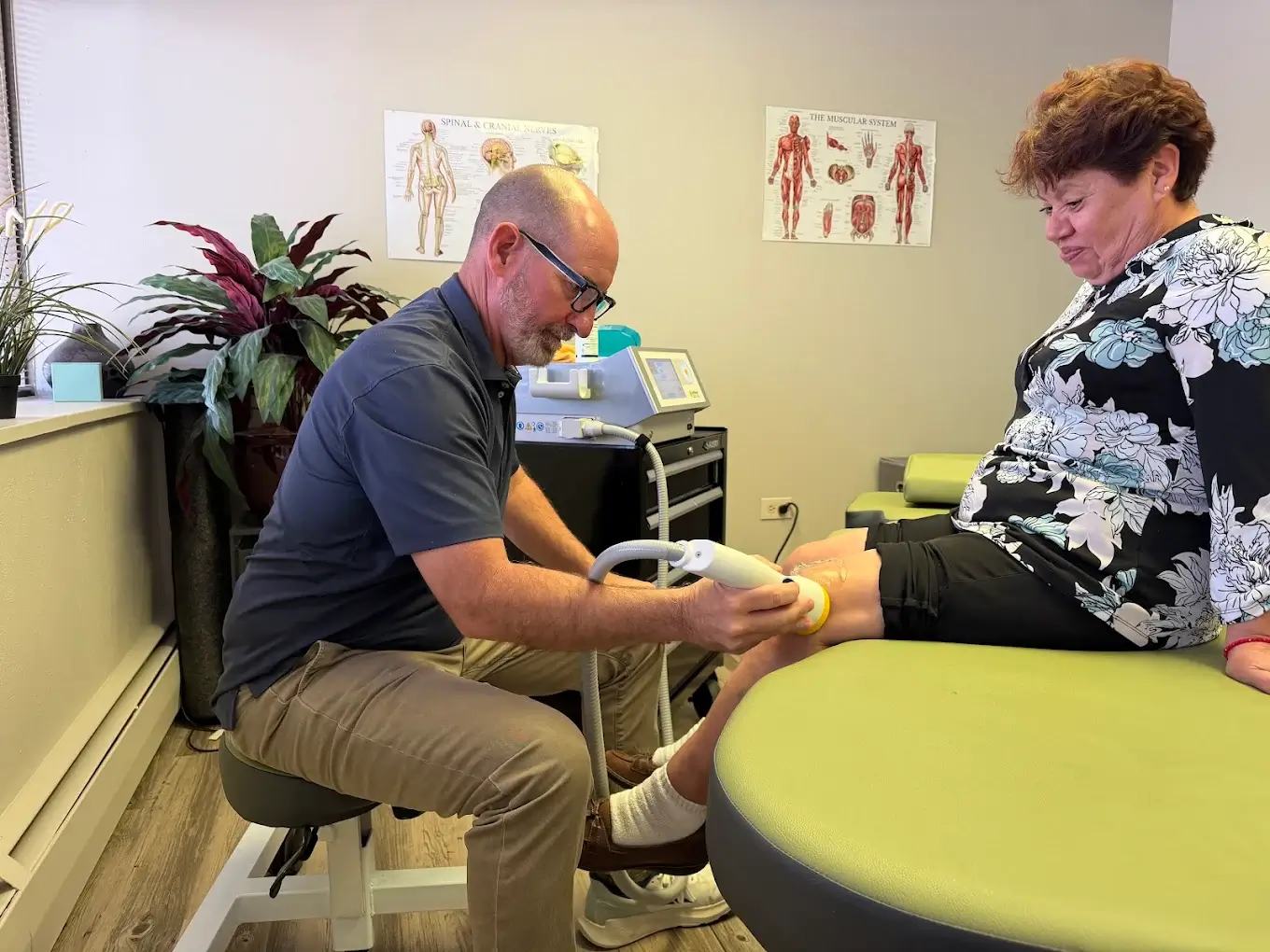
Shockwave therapy involves sending acoustic sound waves into damaged tissue. Dr. Tony Nicholas uses a shockwave device on his patients at Axis Health and Wellness in Centennial to treat their knee and shoulder injuries that don’t respond well to chiropractic care alone.
You might have heard of it from a friend whose tennis elbow has been treated with this therapy. It’s a real therapy that leaves your knee exactly where it was before the injury.
This therapy involves no needles or incisions. There’s also no downtime. It can take around 10 minutes to complete. Dr. Tony’s shockwave device is a SoftWave unit, and the results changed how he treats injuries on knees and shoulders.
What ShockWave Therapy Is?
ShockWave therapy doesn’t involve electricity. It’s mechanical and not electrical. Dr. Tony uses a handheld applicator that sends high-energy acoustic pressure waves through the skin and into the tissue underneath. The waves create a controlled mechanical stimulus at the injury site.
This therapy is in the same category as extracorporeal shockwave therapy (ESWT) or acoustic wave therapy. The word extracorporeal means the energy is generated outside the body. It travels in to make the whole thing non-invasive.
The feeling is like you’re getting an ultrasound. Dr. Tony applies gel onto the affected area. The applicator moves over the spot, and the waves just do their work underneath. You will be fully clothed during the treatment.
Which of the Three Kinds of Shockwave We Use
Radial Shockwave
It involves the use of a pneumatic device to send acoustic waves to relieve soft tissue injury. The energy is strongest at the skin. It spreads outward as it goes deeper. That’s why it’s best suited for treating soft tissue and broad muscular areas. Among the three kinds of ShockWave, this is the least expensive.
Focused Shockwave
This kind of ShockWave is very precise, and it reaches deep structures. The energy converges to a small point at a set depth, like light through a magnifying glass. The treated area is narrow. Thus, to use this therapy, you need to know exactly where the target is.
Unfocused
It’s the one we use here at our Centennial office. Dr. Tony’s device delivers hyperparabolic waves through a stylus. It produces a broad treatment field, instead of a single point. In other words, it covers the whole joint area, rather than one spot. The intensity is low, which is the reason the entire treatment is comfortable and the sessions are short.
The brand name for that unit is SoftWave. You can learn more about this technology on our SoftWave therapy page.
How Shockwave Restarts a Healing Process That Stopped
Cuts can heal. But healing has an off switch. When your condition has been around for too long, your brain shuts down its repair response in that area. It ceases treating your injury. For that reason, your shoulder can hurt at the same level for four years without getting better or worse. The tissue is already damaged, and your body has stopped working on it.
But the ShockWave therapy changes it by sending acoustic waves to the injured areas. The action convinces your brain, over and over, that the area is injured, even though no actual damage happens. As a result, your brain sends blood and stem cells to the site to start repairing the injury. The repair process switches back on, and the damaged tissue is repaired.
“It increases blood flow and it stimulates the stem cells that are already in that area. Once a condition becomes chronic, the brain shuts that part of the healing mechanism off and it no longer tries to heal the area. This triggers that response back on, so people can start healing again.”
Dr. Tony Nicholas, D.C.What We Treat with Shockwave Therapy
You are a candidate for this therapy if you have a joint problem. This therapy is ideal for any injuries to the tendons and joints. These are the cases we see most:
- Arthritic and damaged knees
- Rotator cuff injuries
- Plantar fasciitis and heel pain
- Hip pain
- Osgood-Schlatter disease
- Torn meniscus
- Arthritic shoulders
- Tendinopathy and tendinosis
- Ankle and foot joint pain
- Sever’s disease
Knees are the most common. Dr. Tony never treats a knee with chiropractic alone. He pairs it with shockwave therapy to provide the patients with better results. Shoulders are also common, especially injuries that feel fine sitting still but cause pain the moment you reach overhead.
Where It Shows Up In Your Care Plans
Shockwave can work alongside red light therapy, electrical stimulation, and nutritional support. Dr. Tony has seen it work in various places he didn’t expect. When he applies it over the upper cervical area, it can treat headaches. It has also done really well for patients recovering from brain trauma.
How Shockwave Compares to What You’ve Been Offered
Cortisone Injection
Cortisone lowers inflammation; thereby, it reduces pain. Unfortunately, it doesn’t repair the tissue. For that reason, relief tends to wear off. There are also limits on how often you can have the injection. Shockwave works by repairing the damage, instead of numbing the pain signal. If you have had a cortisone injection, you must wait at least three weeks before treating that site with shockwave therapy.
Versus Surgery
Surgery is permanent, while shockwave is not. Dr. Tony’s mission has been to help as many people as possible without drugs or surgery. Some problems need an operation. He will tell you when your condition is one of them, instead of continuously treating it with non-invasive therapy.
Versus Therapeutic Ultrasound
They look similar. But the mechanism is not the same. Ultrasound delivers heat deep into tissue. Shockwave delivers mechanical pressure waves that trigger a repair response. In other words, they carry out two different jobs.
What a Shockwave Session is Like
- It starts with a consultation and a thorough examination of your condition. Dr. Tony needs to know what he’s treating you for and where your pain sits.
- When he figures out what area to be treated, the treatment starts on the same-day visit.
- He’ll apply gel on the treatment area, exactly like an ultrasound.
- The applicator moves over the target area. You will feel a firm tapping or thumping sensation. It’s not painful, so it doesn’t need numbing.
- After 10 minutes, the therapy is over. There’s no recovery time. You can go back to work or go to the gym.
- Each week, you will be reevaluated. Treatment may be paired with spinal decompression or adjustments. It depends on what your case needs.
Who Should Not Undergo Shockwave Therapy
You can try it once or twice to find out if your body responds to it. This is how safe this therapy is. Dr. Tony has not seen a bad reaction to the device. Some patients may experience extra swelling after the treatment. But it settles within a day or two.
The waves don’t injure the tissue and won’t cause further damage. They only signal your brain to start repairing the damaged tissue.
Despite its low risk profile, we don’t use it in the following cases:
- The injured area is close to a pacemaker.
- After a cortisone injection. We wait at least three weeks before treating that site.
If your joint pain is related to a specific trauma, you should get X-rays. A torn ligament, a torn rotator cuff, or a cartilage damage must be ruled out first because they are not issues that shockwave or chiropractic care can’t solve.
How Many Sessions Do You Need and What Is the Cost
Chronic and arthritic problems may need six to ten treatments. Fresh injuries may require fewer, so they need to be assessed every week. Dr. Tony won’t recommend ten sessions when you only need three.
Every week, you must undergo re-evaluation. In that way, Dr. Tony can determine whether or not your condition has improved. If you have reached 8 sessions without meaningful improvement, Dr. Tony will refer you out. You won’t be given a 60-visit package.
Your first shockwave visit is $49. This is the low-risk way to know whether or not your body responds to it. If your body responds to this therapy, you can choose to pay every time you visit our clinic or choose a plan and pay upfront. We also offer a no-interest payment plan that you can pay up to two years. We take HSA and FSA cards, CareCredit, Cherry, cash, and credit cards. We also accept all insurance, except Medicaid. Check out our payment plans page here.
Shockwave Therapy FAQs
Is shockwave therapy the same thing as SoftWave therapy?
SoftWave is a brand of shockwave device. It is the machine we use here at our Centennial office to treat our patients using shockwave technology. You may read our fuller explanation of the device here on our SoftWave therapy page.
What is the difference between radial, focused, and unfocused shockwave?
Radial devices are pneumatic, and they put their strongest energy at the skin. They spread it outward as depth increases, making them suitable for shallow soft tissue. Focused devices, however, converge energy to a small point at a certain depth. It’s precise but narrow. Unfocused devices, on the other hand, deliver a broader treatment field using lower intensity across a wider area.
Dr. Tony uses an unfocused device that sends hyperparabolic waves through a stylus. It covers the whole joint region, instead of a single point.
What does shockwave therapy feel like?
Most patients describe a firm tapping or thumping over the joint. It’s painless, so you don’t need numbing cream. The setup feels like you’re undergoing ultrasound. There are no restrictions after the session. You may get a little extra swelling in the treated area but it clears up within a day or two.
How is shockwave therapy different from a cortisone shot?
Cortisone lowers inflammation to quiet down the pain. It doesn’t repair the damaged tissue. That’s why the relief wears off. Shockwave, however, targets repair rather than numbing the pain. It restarts the healing response in that injured area. If you’ve had a cortisone injection, we wait at least three weeks before treating that area.
Is shockwave therapy the same as therapeutic ultrasound?
No, they are not the same, even though they are similar. Ultrasound delivers gentle heat into deep tissue. Shockwave delivers mechanical acoustic pressure waves that trigger a biological repair response. It increases blood flow and stimulates the stem cells present in that tissue. They follow different mechanisms and perform different jobs.
How soon will I notice results from shockwave therapy?
It varies by person and how long the problem has been there. Dr. Tony will recommend trying one or two treatments first. If you get 100 percent relief, you can choose to continue. You are re-evaluated each week either way.
Can shockwave therapy help me avoid knee or shoulder surgery?
It depends. Shockwave is non-invasive and reversible. But surgery is not. Thus, you should try it out first, and your first treatment will only cost you a little. Dr. Tony’s mission is to help people without the use of surgery or drugs. He will be straight with you when a problem needs orthopedic surgery, instead of persuading you to undergo treatment here.
Is shockwave therapy covered by insurance?
The coverage varies depending on your plan. But we do accept all insurance except Medicaid. We also take HSA and FSA cards, CareCredit, Cherry, cash, and credit cards. Payment plans are also available. You can choose from our different no-interest options that you can pay up to two years. Your first visit will cost you $49. Call (303) 221-1185 before you commit to anything.
Find Out Whether Your Joint Responds, for $49
One or two sessions is usually enough to tell. Dr. Tony will examine you first, tell you honestly whether shockwave is the right tool for your case, and treat you the same day when it is. Axis Health and Wellness has served Centennial, Greenwood Village, Lone Tree, Highlands Ranch, Littleton, Aurora, Parker, Castle Rock, and the south Denver metro since 1997.